Few people have watched the American whisky market evolve as closely as Sam Filmus. Over nearly three decades, the founder of ImpEx Beverages has seen the industry transform from a niche enthusiast category into a global collectible phenomenon and now into a market searching for its next chapter.
Sam Filmus is the founder and president of ImpEx Beverages and JVS Imports, and one of the most respected figures in the American spirits industry. Honored as a Keeper of the Quaich, he has built a business around introducing American drinkers to whiskies they might never have discovered otherwise – from India and Taiwan to independent bottlers producing single-cask releases in tiny quantities.

Sam’s choice of focusing on the lesser known and the independent bottlers and not necessarily being widespread on shelves is an interesting one. “The hardest part starts with me saying no to some casks, and I’m saying ‘no’ to a lot of casks, and it’s very difficult to say ‘no’… They’re solid whiskies and all this stuff, but that would probably be the hardest part… being in this kind of time as we are right now probably makes it very difficult because if it was like 2021, 2022, even the beginning of 2023, anything you had in your warehouse would be sold, no problem.” We all know it’s not the case any more, and the entire market is More calculated as to its choices.
Though we’d like to believe it’s different, most of the time, life shapes the way you do business rather than the other way around. In an era when many importers chase brands consumers already recognize, Filmus has built a business doing almost the opposite: introducing American drinkers to distilleries and independent bottlers they’ve never heard of. “When I ran the distribution company about 2002 we started with Signatory and then Gordon & MacPhail people approached us to represent their brands in California, and then came with Benromach. There were a lot of other independent bottlers coming on board. We kind of became like a house of independent bottlers.”
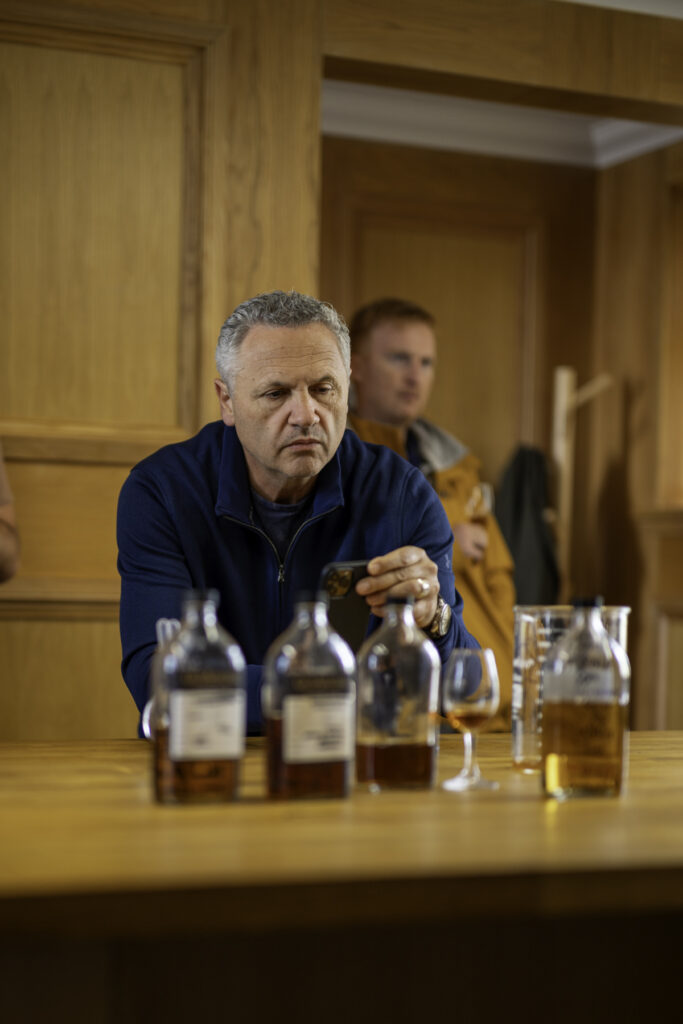
Despite today’s challenging market, Filmus remains cautiously optimistic. “People change their buying habits…but there’s still a good number of people who enjoy craft, who enjoy something that’s one-off. As you know, with the ImpEx Collection, we do one cask at a time, and the number of bottles is limited. So if this cask just throws 224 bottles – 224 people will get it, and it’s gonna be gone for good before another cask shows up on the horizon or another independent bottler brings something exceptional. So that kind of keeps us successful and in business.”
The art of sustaining a successful business in challenging times becomes trickier. The art of choosing a brand or a cask to import to the U.S. market requires careful judgment and criteria. What are the ones that Sam is using? “My first thing… would be the people behind the distillery. That’s number one. I want to make sure that we share the philosophies, we share the passion, we share the enthusiasm and understanding what the American market needs as well as them trusting me by knowing what the American market needs. That’s number one thing. Number two would be the quality and taste, and as a matter of (principle) I don’t see the prices before I taste them, that goes to the ImpEx Collection specifically. And number three would be prices and how much is gonna be acceptable to the American market because of our three-tier system.” It’s a philosophy that runs counter to today’s increasingly price-sensitive whisky market. For Filmus, quality still comes first; commercial viability comes second.
So what does it take to survive today’s whisky business? According to Filmus, the answer has little to do with chasing trends. It begins with transparency – telling consumers exactly what’s in the bottle – and continues with education, tastings, and a genuine passion for introducing people to new whiskies. For him, long-term trust matters more than short-term sales.
As whisky moves into a more disciplined market, Filmus doesn’t seem interested in chasing trends. His approach remains remarkably unchanged after nearly three decades: find exceptional casks, tell honest stories, educate consumers, and trust that quality eventually finds its audience. In a market built on hype, that consistency may be his greatest competitive advantage.